
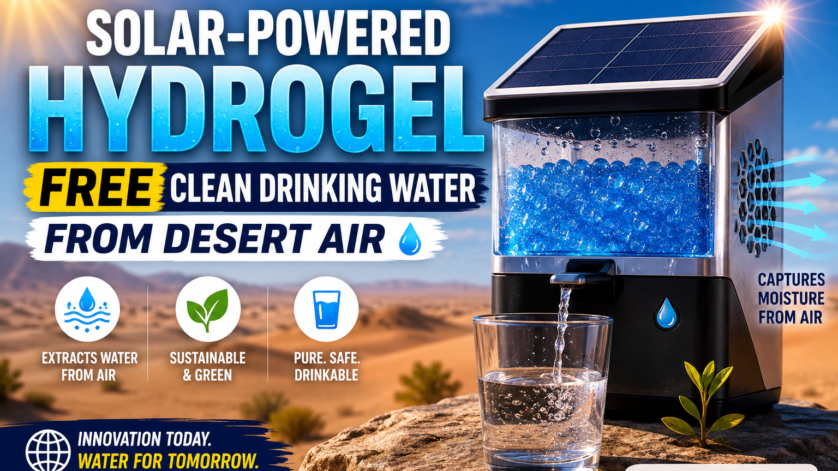
💧 Solar-Powered Hydrogel
Creates Clean Drinking Water from Desert Air
🌍 A breakthrough in water science. Researchers from Stanford University and MIT have developed a longer-lasting hydrogel that can pull moisture from the air and turn it into drinkable water using only sunlight. This technology could help dry regions where traditional water sources are scarce.
💧 How Does the Hydrogel Work?
The material is a sponge-like mix of two components. First, lithium chloride, a highly absorbent salt. Second, polyacrylamide, a polymer also used in products like diapers. Together, they create a powerful water-absorbing gel.
Here is the process: The hydrogel absorbs water vapor from the air at night. When sunlight hits the material during the day, it heats up. That heat releases the trapped moisture as vapor. Then, the vapor condenses into clean, drinkable water.
Earlier field tests in Chile’s Atacama Desert (one of the driest places on Earth) used a panel of this material mounted on a black-painted aluminum sheet. The sheet absorbed heat from the sun and helped the hydrogel release collected water efficiently.
🔧 Fixing a Durability Problem
The material worked well in early tests. However, it only lasted about 30 fill-and-release cycles before breaking down. This created two major issues: cost and safety. Degraded salt or polymer could enter the condenser and affect water quality.
After four years of lab work, the team found the root cause. The metal surface holding the hydrogel was releasing ions. These ions formed damaging radicals inside the gel, which then broke down the polymer chains.
📚 Published in Nature Communications
The study was published in Nature Communications on May 7, 2026. The paper stated that the coating strategy allowed stable moisture absorption and release for more than 190 cycles over 96 days. It also said the approach could create a path toward producing water from air for less than $0.01 per liter.
💰 Cost Could Fall Sharply
Carlos Diaz-Marin, assistant professor of energy science and engineering at Stanford’s Doerr School of Sustainability and co-lead author of the study, explained that the improvement could eventually bring the cost of water produced this way to about one cent per liter.
That would be roughly 1% of the cost of bottled water and close to the cost of tap water in many US cities. This makes the technology extremely promising for low-income regions.
📊 Current Output and Future Goal
The current design can produce up to two liters of water per day. It uses a thin layer of material spread across a panel roughly the size of a bath towel. Stanford researchers say that is about the amount needed per person per day for basic health during emergencies.
Diaz-Marin wants to increase output to five liters per day. That goal could make the system much more useful for rural communities in dry inland regions where desalination is not practical.
⚠️ Not Ready for Large Scale Yet
The technology is not ready for widespread deployment yet. However, the researchers are actively working to improve efficiency and reduce costs even further.
The hydrogel approach is one of several emerging technologies designed to pull water from the air. Other researchers are also studying metal-organic frameworks (MOFs), which can capture water at very low humidity levels. The new work shows that durability may be just as important as water capture itself. Without a longer-lasting material, water harvesting from air would remain too expensive and unreliable for practical use.
🔬 The Bigger Picture
This breakthrough proves that sustainable, low-cost water solutions are possible. With further research, solar-powered hydrogels could provide clean drinking water to millions of people in arid regions across Africa, the Middle East, and South Asia – including parts of Pakistan facing water scarcity.
The team’s focus on durability is what sets this work apart. Previous attempts failed because materials broke down too quickly. Now, with 190+ cycles achieved, commercial applications become realistic.